3XX redirects are HTTP status codes in the 300-399 range that tell a browser or search engine crawler that a URL has moved to a different location. When a server returns a 3XX response, it includes a Location header pointing to the new URL. Both users and search engines follow this instruction automatically. The specific code within the 3XX range determines whether the move is permanent or temporary, and how link equity is treated.
All 3XX Status Codes Explained
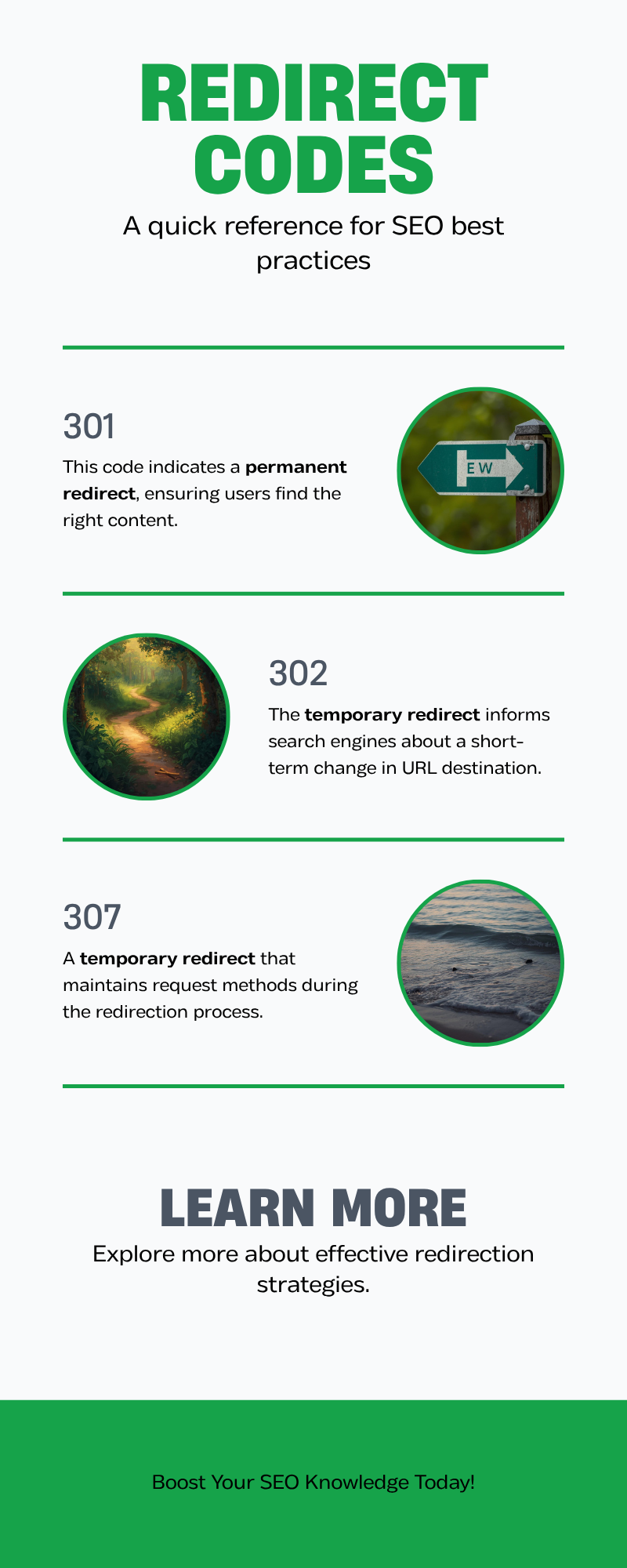
301 Moved Permanently
The most commonly used redirect in SEO. A 301 tells search engines that a page has permanently moved to a new URL. Google transfers the original page's PageRank (link equity) to the destination URL. Use 301 for all permanent URL changes: site migrations, HTTPS upgrades, www to non-www consolidation, deleted pages with replacement content, and URL restructuring.
302 Found (Temporary Redirect)
A 302 tells search engines the move is temporary. The original URL remains in the index and link equity is not fully transferred. Use 302 only when you genuinely intend to restore the original URL later, such as during A/B testing, maintenance periods, or promotional campaigns with temporary landing pages. Using 302 when you mean 301 is a common mistake that can dilute your rankings. See our full 302 Redirect guide.
307 Temporary Redirect
307 is the HTTP/1.1 equivalent of 302. The key difference is that 307 strictly preserves the HTTP method (GET, POST, etc.) of the original request, while 302 historically allowed method changes. From an SEO perspective, 307 behaves like 302: temporary, no guaranteed link equity transfer, original URL stays indexed. Use 307 instead of 302 for modern HTTP/1.1+ servers when method preservation matters.
308 Permanent Redirect
308 is the permanent version of 307: it preserves the HTTP method AND is permanent. It is the HTTP/1.1 equivalent of 301. From an SEO perspective, 308 behaves like 301: permanent, full link equity transfer, destination URL gets indexed. Most SEO scenarios use 301 as it has broader compatibility with older systems, but 308 is equally valid on modern infrastructure.
303 See Other
303 is used after a form submission to redirect the user to a confirmation page. It prevents the "do you want to resubmit?" browser dialog. From an SEO perspective, 303 is rarely seen in normal page-to-page redirects and does not pass link equity. It is mainly used in web application logic.
Which Redirect Should You Use?
- Permanently moving a page: Use 301 (or 308 on modern servers)
- Temporarily redirecting during maintenance or A/B test: Use 302 (or 307 on modern servers)
- HTTP to HTTPS migration: Use 301
- www to non-www (or vice versa): Use 301
- After a form submission: Use 303
- When you are unsure: Default to 301 for any permanent change
3XX Redirects and SEO
- Every redirect adds approximately 100-500ms of page load time. Minimise redirect chains
- Internal links should point directly to the final URL, not through redirects
- Sitemap.xml should only contain final destination URLs, not redirecting URLs
- After a site migration, monitor Google Search Console for 3XX pages and update internal links to remove unnecessary redirect hops